

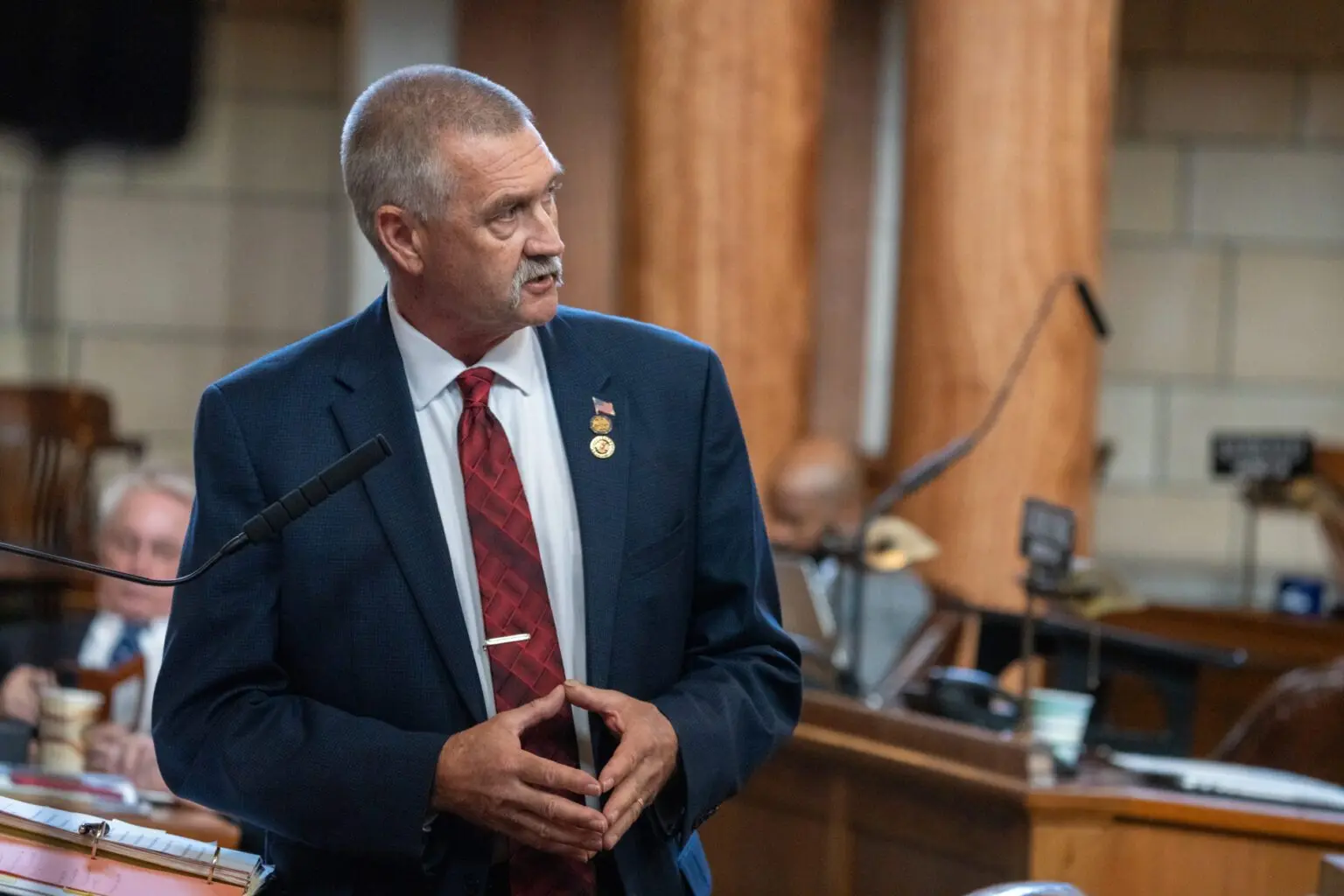
District 15 Senator Dave Wordekemper during Monday’s discussion of the LB 400.
—
Zach Wendling
Nebraska Examiner
LINCOLN — A legislative effort that could make it easier for Nebraska firefighters to receive workers’ compensation for cancers went up in smoke Monday on the bill’s fifth day of debate.
Legislative Bill 400, from State Sen. Dave Wordekemper of Fremont, would have given professional and volunteer firefighters the assumption that any cancer diagnosis they receive in the course of or resulting from their duties is because of firefighting, opening the door to file for workers’ compensation coverage.
The bill failed 32-15, just one vote shy of invoking “cloture” to shut off debate after eight hours.
“This bill is very important to me, on behalf of all of the firefighters, because it’s about whether we stand with the men and women who protect us or whether we turn our backs on them when they need us most,” Wordekemper said in January.
‘Rebuttable presumption’
Under the bill, cancer would be deemed an occupational disease if a firefighter who got cancer had been exposed to a list of known carcinogens in their work. A firefighter also could demonstrate, on a case-by-case basis, that another substance to which they were exposed is reasonably associated with cancer to qualify.
It would be up to local municipalities to rebut the claim that a cancer diagnosis was job-related, shifting the responsibility from firefighters and their families. LB 400 would add a “rebuttable presumption” to state workers’ compensation laws, shifting the burden of proof to the employer, a first for the state.
City and village officials could use a firefighter’s family history, medical records or other behaviors, such as smoking, to prove their case, which Wordekemper says would be more fair.
Lawmakers debated LB 400 for five hours across four days in January. Wordekemper requested time to work with opponents, notably the League of Nebraska Municipalities, which advocates for the state’s more than 520 municipalities and maintained its opposition.
No deal was reached, Wordekemper and the League confirmed.
Twenty-eight states have similar legislation, Wordekemper said, including Iowa, which started with 14 specific cancers but expanded coverage to all cancers last year.
“When I speak about what firefighters face, I’m not speculating. I’m not reading from a report,” said Wordekemper, a professional firefighter for 30 years and a volunteer firefighter for eight, who said he had responded to thousands of emergency calls.
‘Stacking the deck’
State Sen. Mike Jacobson of North Platte, who is fighting skin cancer and beat prostate cancer years ago, was among those leading opposition to the bill. He described it as the “mother of all unfunded mandates” and said anyone eligible would file a claim, driving local costs “through the roof” and increasing property taxes.
Jacobson said LB 400 was “stacking the deck” against cities and villages and “saddling them” with what would be “unprecedented levels of claims that they simply cannot afford.”
“It’s just a money grab, that’s all it is,” Jacobson said. “This is not protecting anybody.”
Amid potential talks to remove volunteer firefighters from the bill, Jacobson added Monday: “This is just another case where we have another year that goes by, and the paid firefighters are wanting something more than they already have right now.”
‘They’re heroes’
State Sen. Danielle Conrad of Lincoln, who supported LB 400, pushed back on Jacobson. She said firefighters aren’t in the best position to know the risks or hazards they face in every call and that they’re not “takers.”
“I think they’re heroes,” Conrad said. “I don’t think firefighters are coming hat in hand to their Legislature for a money grab.”
Multiple senators, such as State Sen. Jared Storm of David City, worried that adding a “rebuttable presumption” to the law would set a new precedent that other unions would pursue.
Conrad, an attorney, said rebuttable presumptions are “typical” in law and that there is nothing “new,” “unique,” “strange,” “scary” or “unexpected” about one. She said they’re about “efficiency” and deciding where the “tennis match” of disputes starts.
“They’re not a zero-sum game. They’re not a game over. They’re not all the eggs in the basket,” Conrad said. “They’re a starting point.”
Wordekemper said it isn’t fair for a firefighter to fight insurance companies while fighting cancer and “to prove we already know from science that wearing contaminated gear and running into burning buildings filled with carcinogens cause cancer.”
He said the goal is that a medical expert is consulted before a compensation claim is denied.
‘Moral responsibility’
State Sens. Bob Andersen of Sarpy County, a retired Air Force veteran, said that for those who go into harm’s way when they’re asked, “we have the moral responsibility to try and make them whole as best we can.”
However, Andersen ended up voting against LB 400, saying the language needed to be refined and that he had a “significant bit of caution.”
State Sen. George Dungan of Lincoln similarly said legislators had a “moral imperative” to make LB 400 workable and that he didn’t believe those advancing a “sky is falling” argument.
“We have to support our friends in fire,” said Dungan, who voted for the bill.
‘Thumb on the scales of justice’
State Sen. Tanya Storer of Whitman, whose sprawling north-central Nebraska district was among those fighting historic wildfires in recent weeks, said she’s seen the commitment and passion of all-volunteer firefighters throughout her district.
But she said it would be “irresponsible of anybody to jump on this ship” and support LB 400 without knowing the cost to local fire departments.
Storer and others noted volunteer firefighting departments fundraise, such as for equipment, sometimes using BBQs or food-related events.
“No quantity of spaghetti dinners is going to come up with enough money to pay for this bill,” said State Sen. Mike Moser, a former mayor of Columbus.
Jacobson and other senators, including State Sen. Jane Raybould of Lincoln, who separately battled a rare type of blood cancer during her legislative tenure, said people might face a higher risk of cancer due to their genetics or general exposure to carcinogens. Some lawmakers pointed to farmers dealing with chemicals, fueling vehicles with diesel or even drinking Diet Coke.
Citing the National Institute for Occupational Safety and Health, Wordekemper said firefighters, compared to the general population, face a 9% increased risk for cancer and 14% increased risk for cancer-related deaths.
Moser said Wordekemper’s bill “puts the thumb on the scales of justice toward the worker.” He said assuming occupational cancer is “unfair.”
“It favors the unions. It favors the employees,” Moser said Monday. “And that’s just not, in my opinion, not the ‘Nebraska way.’”
What comes next
Wordekemper himself invoked the wildfires in western Nebraska and said several senators had a “change of opinion” about what possible amendments to his bill should look like.
“Those fires are a vivid, painful reminder of what we are actually talking about,” Wordekemper said.
Storer thanked those same firefighters, particularly those in the Sandhills but criticized those who were looking at the wildfires that burned more than 800,000 acres as a reason to act.
“We’re taking advantage of a tragedy that’s occurred in western Nebraska right now, in particular, with these catastrophic fires,” Storer said. “We’re holding that hostage and grabbing on to the emotion attached with that and using that as an excuse to all of a sudden pass this bill.”
Wordekemper said he was evaluating the outcome of LB 400 and had no immediate comment on future plans, such as for the 2027 legislative session.